
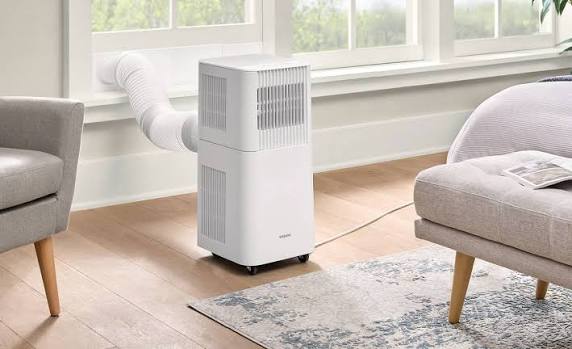
In the UK, we almost exclusively refer to domestic wall units as “air conditioning.” In continental Europe, Scandinavia, and Japan, they are called by their true technical name: air-to-air heat pumps.
If you install a split-system air conditioner to keep your home cool in July, you have also installed an advanced, high-performance heating system for January.
Here is how air-to-air heating works, how its efficiency compares to traditional gas central heating, and why it is transforming UK home energy use.
The Mechanics: How Cooling Becomes Heating
Air conditioners do not create cold air; they extract heat from indoors and dump it outdoors via refrigerant cycle expansion and compression.
Every modern residential unit sold in the UK features a reversing valve. When switched to heating mode, the refrigeration cycle flips in reverse:
- The outdoor condenser draws ambient heat from the outside air (even in sub-zero temperatures as low as -15°C or -20°C).
- The compressor pressurises the eco-friendly refrigerant gas, dramatically raising its temperature.
- The hot refrigerant travels inside to your wall-mounted unit.
- The internal fan blows quiet, warm air directly into your living space, heating the room in minutes.
Efficiency Comparison: Air Conditioner vs. Gas Boiler
The performance efficiency of heating systems is measured by their Coefficient of Performance (COP) or Seasonal Coefficient of Performance (SCOP).
- Modern Condensing Gas Boiler: Operates at roughly 85% to 92% efficiency. For every 1.0 kWh of gas consumed, it produces roughly 0.9 kWh of heat.
- Direct Electric Radiator / Fan Heater: Operates at 100% efficiency. For every 1.0 kWh of electricity consumed, it produces exactly 1.0 kWh of heat.
- Air-to-Air Heat Pump (AC Unit): Operates at an SCOP of 3.8 to 4.5+ (380% to 450% efficiency). For every 1.0 kWh of electricity consumed, it produces 3.8 to 4.5 kWh of heat energy by pulling free thermal energy from outdoor air.
Is It Cheaper to Heat with AC Than a Gas Boiler?
Historically, gas was four to five times cheaper than electricity per unit, which cancelled out the heat pump’s efficiency advantage. However, with modern energy pricing dynamics and gas tariffs:
- Suppose Mains Gas costs 6p per kWh. Delivering 4 kWh of heat via a 90% efficient gas boiler requires ~4.4 kWh of gas, costing ~26.4p.
- Suppose Electricity costs 26p per kWh. Delivering that same 4 kWh of heat via a 4.0 SCOP air-to-air heat pump requires just 1.0 kWh of electricity, costing ~26p.
The running costs are virtually on par for whole-house heating. Where air-to-air units offer significant cost savings is in micro-zoning:
The Power of Micro-Zoning
With wet central heating (radiators piped to a single boiler), you typically have to fire up a 24 kW to 30 kW boiler to warm the whole house just to work in a single home office or sit in a living room.
An air conditioning unit allows you to heat just the room you are occupying. You can bring a chilly home office or bedroom to temperature in under 8 minutes, leaving your central boiler switched off during milder spring and autumn months.
Advantages Over Wet “Air-to-Water” Heat Pumps
While government grants (like the Boiler Upgrade Scheme) focus on air-to-water heat pumps (which replace your boiler and heat your wet radiators and hot water cylinder), air-to-air split systems offer unique practical advantages:
- Rapid Response: Warm air circulates within minutes; there is no waiting hours for large radiators or underfloor pipes to warm up.
- No Pipework Replacements: No need to replace existing copper plumbing or upsize radiators to costly double-panel models.
- True Dual Utility: Air-to-water heat pumps cannot cool your home during a heatwave through conventional radiators; air-to-air systems deliver full summer climate control alongside winter warmth.
Looking to upgrade your heating and cooling in one step?